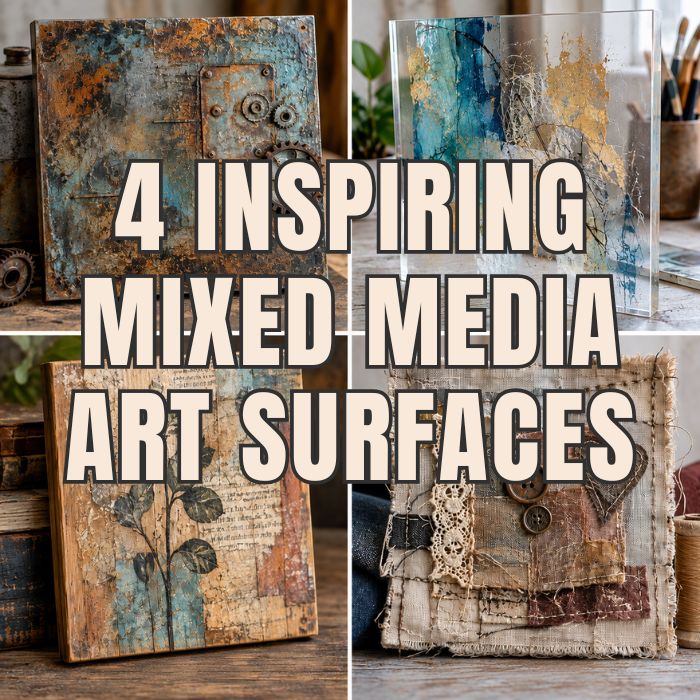
Canvas is the default for good reason: cheap, forgiving, and it accepts almost anything you throw at it. The trade-off is that it never argues back, and after a while the texture turns predictable and the work feels safe. That is where experimenting with different mixed media art surfaces can completely change the way you work. Every other surface asks for something in return, whether that is prep, patience or a different sealant. The reward is that the surface itself becomes part of the creative process.
In this guide, we’ll compare four alternatives to canvas – metal, clear acrylic, wood and fabric, and look at what each surface gives you, what it demands, and which mixed media techniques it suits best.
If you’re new to mixed media, you might also enjoy my 7 Reasons to Create Mixed Media Projects to discover why experimenting with different materials can open up so many creative possibilities.
Metal fights back, and that is the point. Paint beads instead of soaking in, and alcohol inks pool and separate in ways you cannot fully steer. Choose it when you want the surface making decisions alongside you.
The price is prep. For acrylic paint, lightly abrade the surface with fine-grit sandpaper, clean away oils and residue, and use a primer designed for the surface when you want reliable adhesion. You can deliberately skip primer when you want a more experimental, less predictable finish, but understand that this sacrifices some adhesion and repeatability.
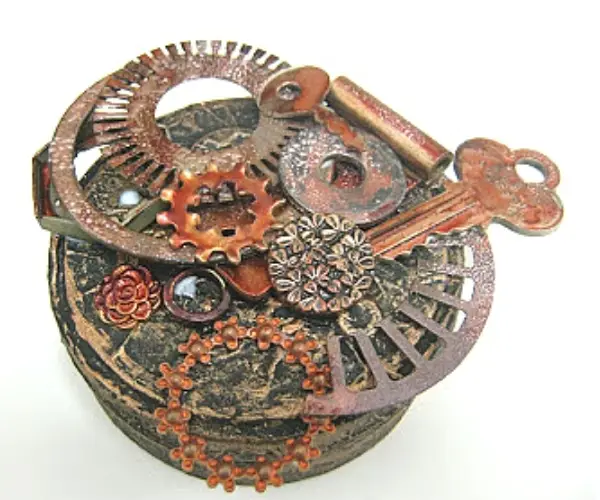
If you enjoy giving ordinary metal objects a new life, take a look at my tutorial for altering a tin box in a steampunk style
Both are valid, but only one is repeatable. Sourcing is easy: thrift shops are full of aluminum baking sheets and tin lids, and scrap steel, old trays and other discarded metal objects can give you inexpensive surfaces to experiment on.
If you want rust, do not wait for the weather. A vinegar, salt and hydrogen-peroxide treatment can accelerate rust on suitable bare iron or steel, sometimes producing visible changes very quickly. The exact timing depends on the metal, surface preparation and application, so treat the first attempt as a test rather than expecting an exact result.
Important: this is for iron or suitable steel, not aluminum or galvanized metal. Always test a small area first, work with appropriate ventilation and protection, and seal the finished surface when you are satisfied with the rust.
Expect to overshoot once or twice while you learn where to stop. That unpredictability is part of what makes rusted metal so interesting as a mixed media surface.
Transparency changes the conversation. You stop painting on a surface and start building on two faces of it, deciding what light does on the way through.
Acrylic is the friendliest way in. It is lighter than glass, it does not shatter, and you can drill it for hanging or stitching. Ordering an acrylic sheet cut to size saves scoring and snapping big panels yourself and lets you specify the exact dimensions a piece needs. Choose the thickness according to the size of the panel and the weight of the materials you plan to attach rather than assuming one thickness will suit every project.
Here is the catch. Smooth acrylic needs preparation if you want reliable paint adhesion. A slight tooth created by sanding, followed by an appropriate acrylic ground or primer, can give the paint a better surface to grip. If you’re working with acrylic paint and want to understand the different mediums that can help you prepare, layer and finish your projects, see my Ultimate Guide to Acrylic Mediums. The exact preparation depends on the acrylic sheet and the paint system you are using, so test your combination before committing to a finished piece.
Alcohol inks are the opposite, feathering into blooms you simply cannot get on paper.
One of the biggest advantages of acrylic as a mixed media art surface is that you can use both sides intentionally. Paint your background details on the back of the sheet, then flip it. The image sits behind the gloss, protected and slightly floating.
Reverse painting has been used on glass since the medieval period and the same basic idea can be adapted to transparent acrylic, although the materials and adhesion requirements are different.
This makes clear acrylic especially interesting when your mixed media art is about depth, transparency, layering or light.
Wood is the low-risk choice. Offcuts cost nothing at many timber yards if you ask nicely, and plywood, poplar and cedar shims all take gesso and modeling paste beautifully. Cradled birch panels are the tidy shop-bought version; reclaimed fence board brings weathering you cannot fake.
Unlike flexible canvas, a rigid wood panel gives you a stable base for heavier collage, texture paste and dimensional elements. Proper preparation matters, though: wood can absorb moisture, and sealing and priming can help create a more consistent painting surface.
The trade-off is that wood is more predictable than some of the unconventional surfaces in this article, which can be an advantage when you want control.
Old hardback covers are underrated. Strip the pages, keep the boards and spine, and you have a hinged surface with a story already in it. For artists who work with altered books, junk journals or found materials, an old book cover can also become part of the meaning of the finished piece rather than simply a support. Vintage book cloth takes ink and paint with unusual softness.
Found paper is the cheapest experiment going, as long as you back it before any wet media:
This type of paper is particularly useful when you want the history, typography, handwriting or printed marks of the material to remain visible underneath your own layers.
Nothing says a substrate has to be rigid. Canvas drop cloth, painter’s canvas by the yard, upholstery scraps and denim from worn-out jeans all take paint and stitch, and stitch is a mark you cannot make anywhere else on this list.
Fabric also introduces movement and softness that rigid mixed media art surfaces cannot provide. Acrylic paint can be used on many fabrics, but the choice of paint and medium matters if the finished piece needs to remain flexible or washable.
Leather scraps from a cobbler are worth asking about: vegetable-tanned leather accepts alcohol dye, tooling and heat embossing, and it ages into something warm.
And if you’d like to experiment with the look of leather without using actual leather, here’s my tutorial for making realistic faux leather paper
Vegetable-tanned leather is particularly suitable for tooling, stamping, carving and dyeing because of the way it responds to moisture and pressure.
The catch is buckling. Flexible surfaces warp as wet media dries, so stretch fabric over a frame or stiffen it with fusible interfacing first. For textile painting, securing the fabric to a stable support can also make brushwork and paint penetration easier. If you want the fabric to behave more like a rigid mixed media surface, backing or mounting it to a firm support can give you much greater control while still preserving the texture of the weave.
The useful question is not which surface is best. It is which surface argues with your idea in an interesting way.
Before choosing a substrate, think about four things:
Want marks crisp and controlled for the least prep? A prepared wood panel is a practical choice. Want them to bleed and surprise you? Fabric, found paper or an intentionally under-prepared surface can introduce more variation. Chasing light and depth? Acrylic. Making something about memory or time? Rusted metal or a book cover carries that meaning before you lift a brush.
There is no single “best” surface for mixed media art. The right surface depends on the materials you want to use, the amount of texture you plan to build, and how much control, or unpredictability, you want from the substrate.
Buy one unfamiliar surface next time you are shopping. Just one. Work on it badly, learn what it does, then try again. That second attempt is usually where things get good.
Save it for later – PIN IT!
Have fun creating!